
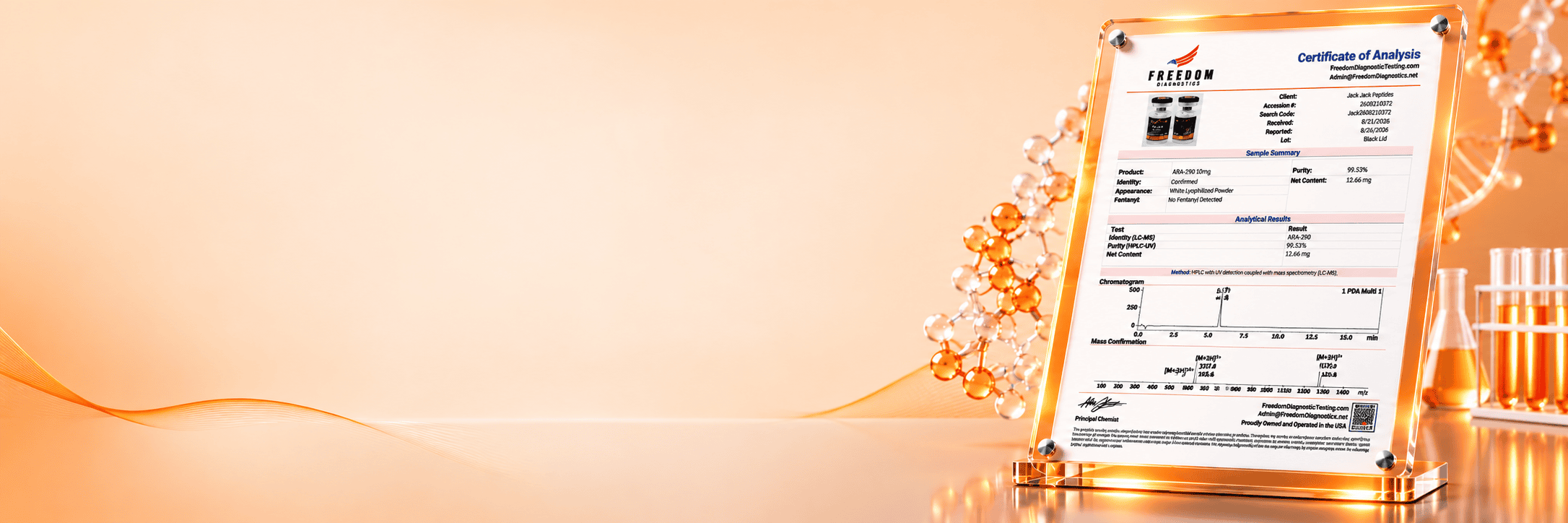
What is a Peptide Certificate of Analysis (CoAs)? Understanding Every Section of a Lab Report
- Published on:
Last Updated: November 10, 2026
Table of Contents
A peptide Certificate of Analysis (CoAs) is the document that shows what is in a vial and how it was verified. In this guide, we explain every section of a peptide CoAs, from sequence and molecular weight to HPLC purity and acceptance criteria, so you can read one with confidence. This content is for education only. We do not offer medical advice.
What is a Peptide Certificate of Analysis (CoAs)?
What is a peptide CoAs? It is a lot-specific quality document, issued by a manufacturer or a testing laboratory, that reports the identity, purity, and other test results for one batch of a peptide. The peptide CoAs meaning is simple: a record of what was tested, how it was tested, and what the results were. Synthetic peptides are usually made by solid-phase synthesis and obtained as TFA salts, with identity confirmed by LC-MS and purity determined by LC-UV.[1]
Why is a Certificate of Analysis Important for Research Peptides?
A research peptide Certificate of Analysis matters because experimental results are only as reliable as the material tested. Unverified identity, hidden impurities, or unknown salt content can distort data and make studies hard to reproduce. Researchers working with synthetic peptides stress that counterion content should be quantified and specified.[1] A CoAs also gives your lab a documented record to file with its own notebooks.
What Information Should a Research Peptide CoAs Include?
A complete peptide CoAs includes the fields below. The entries shown are a peptide CoAs example for illustration only, not a real batch.
| CoAs Field | Illustrative Entry | What it Tells You |
| Product name | Example Peptide | The compound tested |
| Sequence | Ala-Gly-Ser-Leu-Val | The intended amino acid order |
| Lot number | EX-0001 | Which batch the results describe |
| Test date | 2026-01-15 | When testing occurred |
| Appearance | White lyophilized powder | Physical form of the sample |
| Molecular weight (expected / observed) | 445.5 Da / 445.6 Da | Identity check by mass spectrometry |
| HPLC purity | 98.7% | Share of target peptide among peptide-related species |
| Net peptide content | Reported if tested | Peptide share of total weight |
| Testing laboratory and method | Lab name, RP-HPLC, LC-MS | Who tested and how |
| Specification and result | Limit of 98% or higher, pass | The limit and the outcome |
What Do Peptide Name, Sequence, and Molecular Weight Mean on a CoAs?
The name and sequence define what should be in the vial, written as amino acid codes from the N-terminus to the C-terminus. Molecular weight is the mass calculated from that sequence. A CoAs usually lists an expected value and an observed value from Mass Spectrometry, and close agreement supports identity. Salt form matters too: in one study, a peptide with a calculated weight of 1,296.50 Da had a calculated weight of 1,752.58 Da as a TFA salt.[1]
What Are HPLC and Mass Spectrometry Results on a Peptide CoAs?
Reversed-phase HPLC separates a sample by hydrophobicity. In the chromatogram, the main peak represents the target peptide and smaller peaks represent by-products. Synthetic peptides are routinely purified and characterized this way.[2] Mass spectrometry measures mass-to-charge ratio to confirm molecular mass, and it is a core method for exploring the composition and structure of proteins and peptides.[3] In short, HPLC answers how pure the sample is, and mass spectrometry answers what it is.
What Do Purity, Identity, and Peptide Content Mean on a Lab Report?
Purity is the percentage of target peptide relative to peptide-related impurities, as measured by HPLC. Identity is confirmed by mass, and sometimes by amino acid analysis. Peptide content is how much of the vial’s weight is actually peptide, with the remainder being water and counterions. A 98% pure peptide can therefore contain far less than 98% peptide by weight. In one study, TFA reached up to 35% of the weight of the peptide salts tested.[1]
What Are Specifications and Acceptance Criteria on a Peptide CoAs?
Specifications are the limits a lot must meet, such as a minimum purity or an allowed mass difference. Acceptance criteria are the pass or fail rules applied to each result. Regulators describe the validation of analytical procedures through specificity, range, accuracy, precision, and robustness, so that methods are fit for purpose.[4] That guidance is written for commercial drug testing, so treat it as a benchmark rather than a requirement for research materials. On a peptide CoAs, look for a stated limit beside every result.
What Does a Peptide CoAs Tell You About Laboratory Testing?
The laboratory name, test date, method, and instrument show who tested what. A peptide lab testing report from an accredited laboratory adds confidence, because ISO/IEC 17025 sets requirements for the competence, impartiality, and consistent operation of laboratories.[5] Check that the lot number matches your vial and that chromatograms and spectra are attached, not just a summary line.
What Are the Limitations of a Research Peptide Certificate of Analysis?
A research peptide Certificate of Analysis is informative, not a guarantee. It reflects the sample and date tested, so it cannot prove every vial is identical. HPLC purity does not account for water or counterions, and identity and purity tests do not establish sterility or endotoxin levels unless those tests are listed. It also cannot make a research material suitable for human use. Treat it as one piece of evidence and ask the supplier about missing data.
Why Choose Jack Jack Peptides?
Jack Jack Peptides supplies research peptides for laboratory use only, not for human or veterinary use.
- We prioritize third-party testing for purity and quality.
- We provide CoAs access so researchers can review analytical data.
- We supply research-grade compounds exclusively for laboratory investigation.
- We offer secure, temperature-controlled shipping for laboratory sourcing.
- Our team provides dedicated support for product and documentation questions.
You can review documented products at the Jack Jack Peptides Shop.
The Bottom Line
A CoAs turns a label claim into checkable evidence. Sequence and molecular weight show what the peptide should be, HPLC and mass spectrometry show whether it matches, and the specifications, laboratory details, and limitations show how far to trust the result. Jack Jack Peptides supplies research peptides for laboratory use only, not for human or veterinary use.
Ready to apply your understanding of a Peptide Certificate of Analysis and request the documentation your study needs? Our team is here to help.
Frequently Asked Questions
Is a third-party peptide CoAs different from a manufacturer’s CoAs?
Yes. A manufacturer’s CoAs is issued by the party that made the batch, while a third-party CoAs comes from an independent laboratory with no stake in the sale. Independence adds confidence, and accreditation to ISO/IEC 17025 is one signal of a laboratory’s competence and impartiality.[5] When both reports exist for the same lot and agree, the evidence is stronger.
Is a peptide Certificate of Analysis the same as a laboratory test report?
Not exactly. A peptide Certificate of Analysis summarizes results for a lot, while a laboratory test report is the fuller record with methods, chromatograms, and spectra. A good CoAs references or attaches that underlying report.
Does every research peptide require a separate Certificate of Analysis?
Each compound and each lot should have its own CoAs, because sequence, molecular weight, and results differ between peptides and between batches. Check that the lot number on the document matches the lot on your vial.
Can a peptide Certificate of Analysis be updated after the original testing date?
A CoAs records results for a specific test date, so it should not change silently. Legitimate updates arrive as a clearly dated revision or as a new report after retesting. Be cautious about documents that change without a revision note or a new test date.

Explore Premium Research Peptides
Discover our range of high-quality, lab-tested peptides for your research needs.
Catrgories
Categories
Recent Posts


PREMIUM
RESEARCH PEPTIDES
Explore quality-focused, lab-tested peptides for research purposes.