
HPLC Explained: How Chromatography Separates Compounds and Measures Sample Purity
- Published on:
Last Updated: November 19, 2026
Table of Contents
Behind almost every purity claim on a laboratory report sits a chromatogram. HPLC is one of the most widely used techniques for checking what is in a sample, yet its results can look like a wall of peaks to anyone who has never run one. Understanding how the method works turns those peaks into evidence you can judge for yourself.
In this guide, we offer HPLC explained in plain language, from the instrument and the separation to the chromatogram and its limits.
What Is High-Performance Liquid Chromatography (HPLC)?
How does HPLC work in practice? In four steps. First, a small volume of dissolved sample is injected into the flowing mobile phase. Second, the pump carries it onto the column. Third, the compounds separate as they travel at different speeds. Fourth, a detector, most often UV absorbance, records each compound as it exits and software draws the result as a chromatogram.[1] The process is automated, which makes runs repeatable.
What Are the Main Components of an HPLC System?
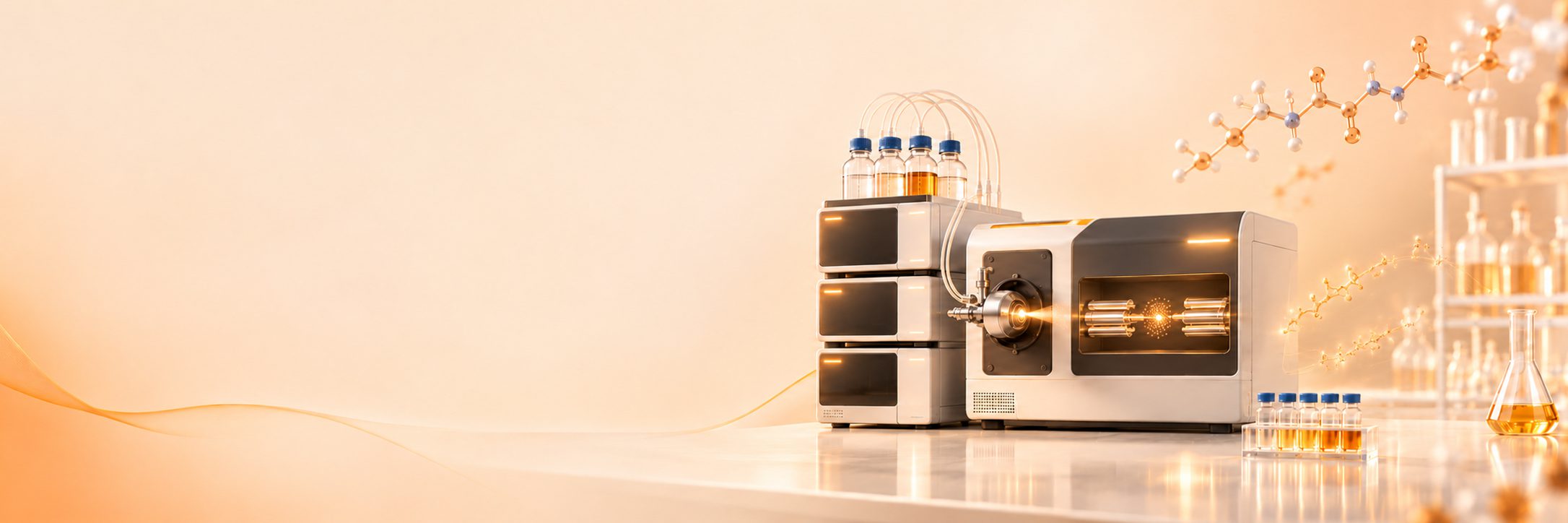
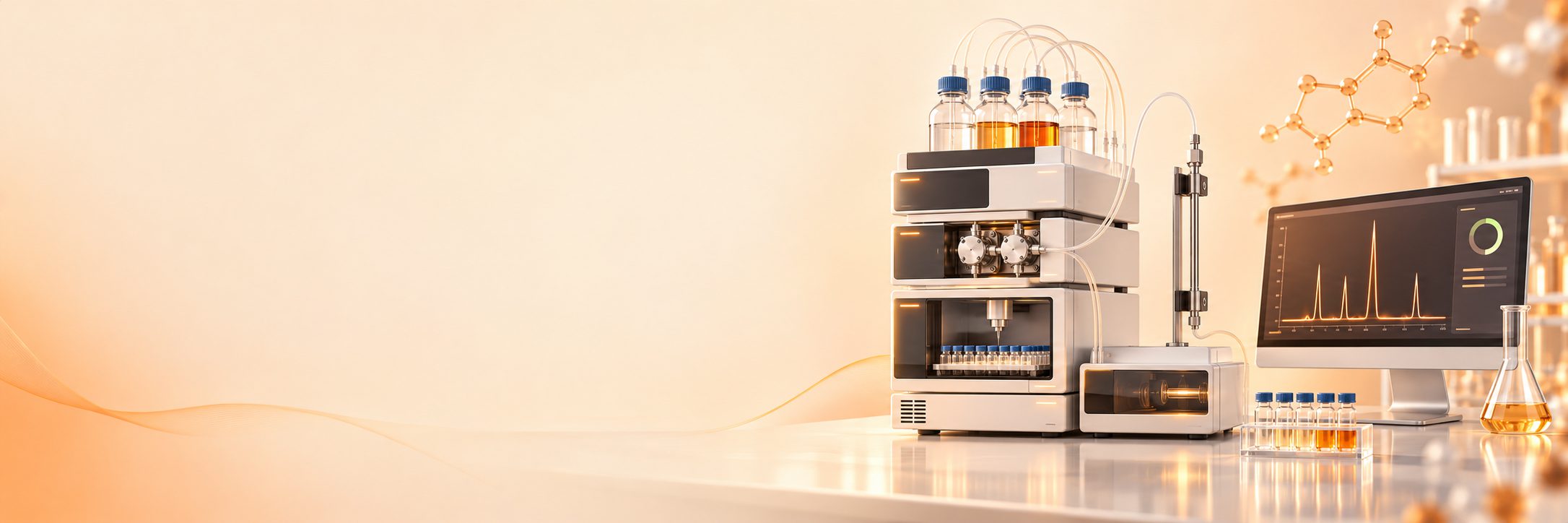
A typical system has five core parts:
- Solvent reservoirs and degasser: hold and condition the mobile phase.
- Pump: delivers a steady, high-pressure flow.
- Autosampler: injects a precise sample volume.
- Column: contains the stationary phase where separation happens, often held at a controlled temperature.
- Detector and data system: measure the signal and plot the chromatogram.[1]
- Together, these parts allow the HPLC method to be tuned for speed, resolution, and sensitivity.
How Does HPLC Separate Compounds in a Sample?
Chromatography separation depends on how strongly each compound prefers the stationary phase over the mobile phase. In reversed-phase HPLC, the most common mode, the column is nonpolar and the mobile phase is more polar, so water-loving compounds leave first and hydrophobic ones are held longer.[1] Peptides are routinely analyzed and purified this way.[2] Analysts often change the solvent mixture over time, called a gradient, to release strongly retained compounds as sharp, well-resolved peaks.
What Does an HPLC Chromatogram Show?
An HPLC chromatogram plots detector signal against time, and each peak represents a compound or group of compounds leaving the column. How to read HPLC results comes down to three observations:
- Retention time: when a peak appears. Under the same method, a compound elutes at a characteristic time.
- Peak area: proportional to the amount detected, and the basis for purity calculations.
- Peak shape and baseline: sharp, symmetrical peaks and a flat baseline suggest a well-behaved method, while tailing, shoulders, or drift suggest problems.
How Is HPLC Used to Assess Sample Purity?
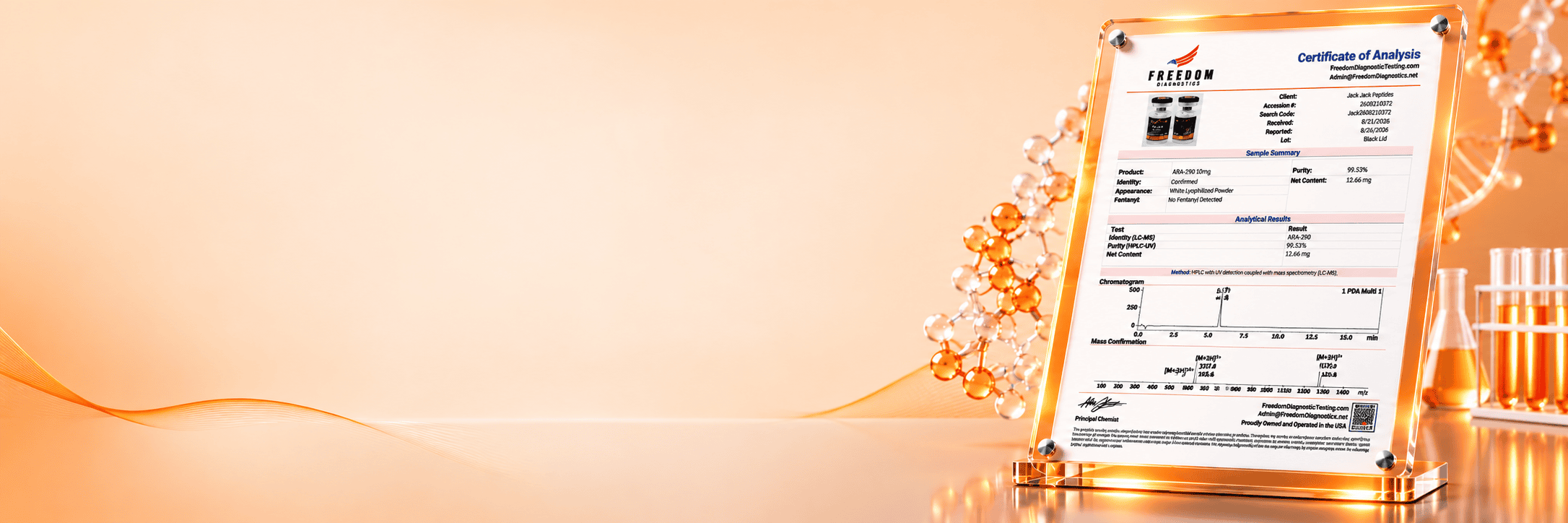
HPLC purity testing usually reports area percent: the main peak’s area divided by the total area of all integrated peaks, multiplied by 100. A main peak covering 98.6% of the total means 1.4% of the detected signal came from other species. Method specificity matters, because a validated method must distinguish the analyte from impurities,[3] so look for the stated column, gradient, detection wavelength, and integration settings. For research materials, HPLC analysis for peptide purity is typically run with UV detection and reported on certificates of analysis.[4]
What Are the Limitations of HPLC Purity Testing?
Purity by HPLC is informative, not complete. Area percent assumes all species respond equally to the detector, which is not always true. Co-eluting impurities can hide under the main peak, and species that do not absorb at the chosen wavelength will not appear at all. The HPLC chromatogram also says nothing about water or counterions: in one study, TFA reached up to 35% of the weight of peptide salts.[4] And HPLC alone does not prove identity, so it is usually paired with mass spectrometry to confirm molecular mass.[5]
Why Is HPLC Important in Peptide Research?
Synthetic peptides can contain closely related by-products, such as truncated or deleted sequences, that differ from the target by a single amino acid. Reversed-phase methods separate many of them, which is why they are used to purify and check peptides.[2] A batch-matched trace on research peptide CoAs lets researchers confirm HPLC purity testing results before an experiment, and consistent traces across lots support reproducibility. Reading HPLC analysis for peptide purity correctly is therefore a core research skill, and HPLC remains the first checkpoint.
Why Choose Jack Jack Peptides?
Jack Jack Peptides is a research peptide supplier focused on documented quality for laboratory investigation. We pair third-party testing with batch-specific records, so every vial can be traced back to its results. Here are why researchers choose us:
- We prioritize third-party testing for purity and quality.
- We provide CoAs access so researchers can review analytical data.
- We supply research-grade compounds exclusively for laboratory investigation.
- We offer secure, temperature-controlled shipping for laboratory sourcing.
- Our team provides dedicated support for product and documentation questions.
The Bottom Line
A chromatogram is a record of separation: retention time shows when a compound left the column, peak area shows how much was detected, and method details show how far to trust the number. Treat purity as one piece of evidence and pair it with identity data.
To review documented, batch-tracked products, browse the Jack Jack Peptides Shop. We supply research peptides for laboratory use only, not for human or veterinary use. Ready to put HPLC data to work in your research and request batch-specific documentation? Our team is here to help.
Frequently Asked Questions
What is the difference between isocratic and gradient HPLC?
Isocratic methods keep the mobile phase composition constant, which is simple and repeatable. Gradient methods change the composition during the run, which suits complex mixtures with a wide range of polarity and sharpens late-eluting peaks.
What factors affect retention time in HPLC?
Mobile phase composition and strength, column chemistry and length, flow rate, temperature, pH, and gradient steepness all shift retention time, as do the compound’s own hydrophobicity and charge. Keeping these conditions fixed is what makes retention time comparable between runs.
Why is C18 commonly used in reversed-phase HPLC?
C18 columns carry long octadecyl chains bonded to silica, creating a strongly hydrophobic surface that retains a wide range of compounds with good resolution and reproducibility. That versatility, plus wide availability, explains its popularity for peptide work.
How long does a typical HPLC analysis take?
It depends on the method. Fast UHPLC screening runs can take a few minutes, while standard gradient methods for complex samples often run from roughly 20 to 60 minutes, plus column equilibration and sample preparation.
What is the difference between HPLC and UHPLC?
UHPLC uses smaller particles and higher pressures than conventional HPLC, giving faster runs, higher resolution, and lower solvent use. Commercial UHPLC systems appeared in 2004 and substantially increased laboratory throughput.
References
- https://chem.libretexts.org/Bookshelves/Analytical_Chemistry/Analytical_Chemistry_2.1_by_David_Harvey/Analytical_Chemistry_2.1_(Harvey)/12%3A_Chromatographic_and_ElectrophoreticMethods/12.05%3A_High-Performance_Liquid_Chromatography
- https://pmc.ncbi.nlm.nih.gov/articles/PMC9059125/
- https://www.fda.gov/regulatory-information/search-fda-guidance-documents/q2r2-validation-analytical-procedures
- https://www.mdpi.com/1424-8247/18/8/1163
- https://www.nature.com/articles/nature19949
- linkinghub.elsevier.com/retrieve/pii/S0165993614002003

Explore Premium Research Peptides
Discover our range of high-quality, lab-tested peptides for your research needs.
Catrgories
Categories
Recent Posts
PREMIUM
RESEARCH PEPTIDES
Explore quality-focused, lab-tested peptides for research purposes.